
Will you have to pay capital gains tax?
When selling real estate, tax is usually calculated on capital gains — the profit between the sale price and the purchase price, taking into account justified investments in the property. From 2025, a 25.5% rate applies to income from capital gains.
Example: if a property was purchased for EUR 100,000 and sold for EUR 150,000, the capital gains tax is: (150,000 - 100,000) x 0.255 = EUR 12,750.
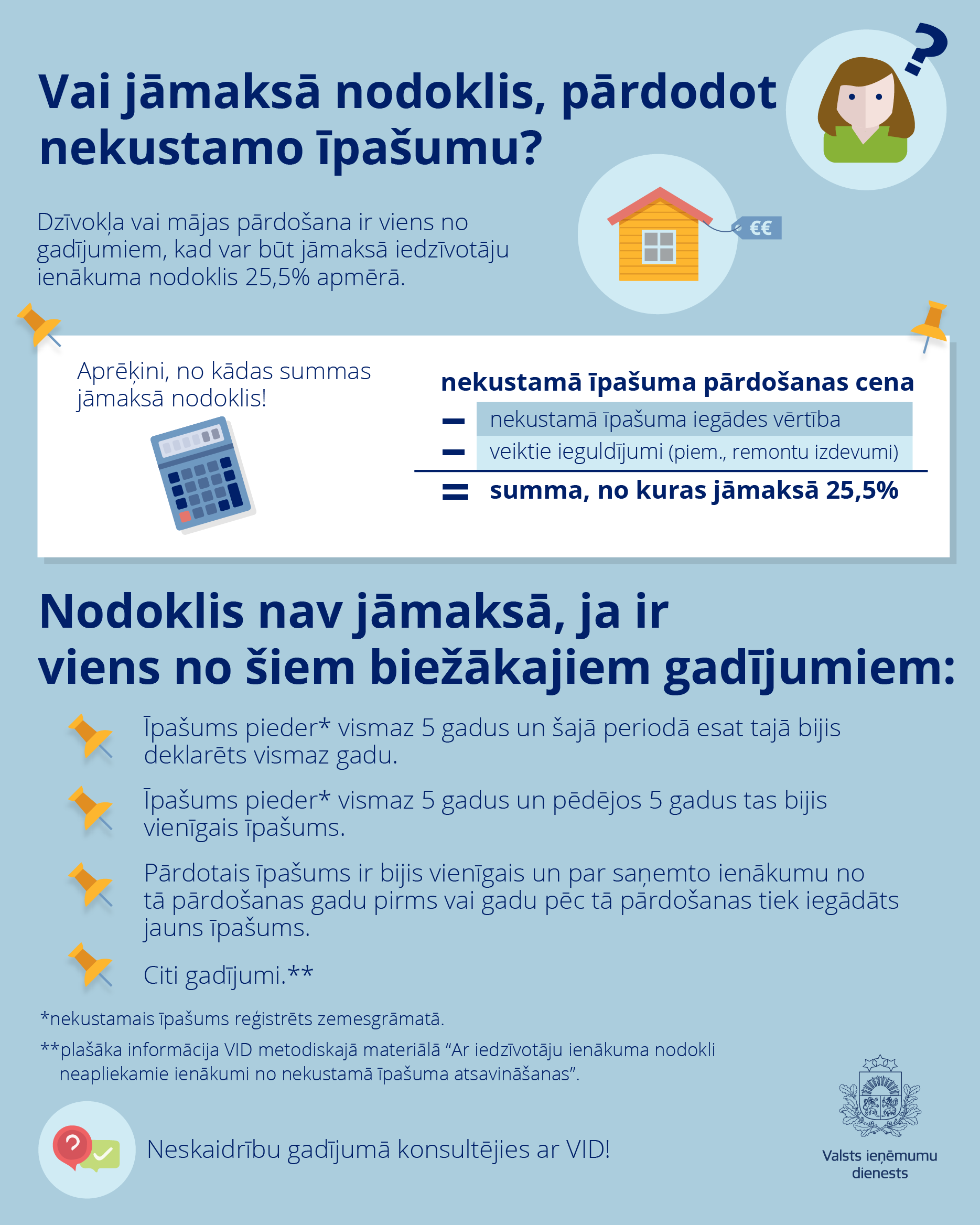
However, tax is not payable in all cases. Exceptions include:
- The property has been owned for more than 60 months and during the last 60 months it was the only real estate owned.
- The property has been owned for more than 60 months and for at least 12 consecutive months within the last 60 months it was the declared place of residence.
- The property is the only real estate owned and the income from the sale is reinvested in a functionally similar property within 12 months before or after the sale.
Are there any unregistered alterations?
One of the most common issues during the sales process is a mismatch between the actual situation on site and official records. A buyer, bank or appraiser may check whether the layout, area and use correspond to Cadastre and BIS data.
Owners are advised to check whether:
- all alterations, extensions, canopies, terraces, outbuildings and room re-plans have been approved and registered;
- the actual area and room layout match the Cadastre records;
- there are no unfinished or unopened cases in the BIS system.
This is important because banks and insurers usually require the property to match official data. Why is this important for the seller? On today's market most buyers finance purchases with bank loans. The bank grants a mortgage loan only if the property can be insured — insurers require that all alterations are approved. In some cases, if approval is straightforward, banks may grant a loan on condition that the buyer legalizes the alteration within 6–12 months. Many buyers are wary of approvals and other risks; the seller's task is to reduce doubts and misunderstandings that may arise.
Do the Land Register and Cadastre records match the property?
Before selling, ensure the property is registered in the Land Register and that the seller is the owner of everything that exists on the ground, including buildings. This check is important for apartments, houses and land plots.
Also consider whether:
- all buildings and groups of premises are registered;
- there are no discrepancies in address, area or designated use;
- there is no situation where the Land Register shows one composition but the physical situation is different.
Such discrepancies can delay valuation, bank financing or completion of the transaction. It is common in practice that land functionally linked to an apartment is recorded in a different Land Register section and the owner may not realize the land belongs to them when selling the apartment without it.
Are there any encumbrances or other legal obstacles?
A buyer typically checks whether the property has a mortgage, a prohibition mark, easements, shared ownership issues or other third-party rights. The Land Register is public and records rights associated with the property.
Before selling, it is advisable to determine in advance whether:
- the property has an active mortgage;
- bank consent or a repayment procedure is required;
- there are easements, lease rights or other encumbrances;
- the property is co-owned and involvement of co-owners will be required in the transaction.
If the property was acquired during marriage, it is usually considered joint property unless another agreement exists.
Which documents are usually needed
In practice, the sales process often requires an identity document, Land Register ownership details, a purchase agreement and an application for entry in the Land Register.
In some cases, spouse consent, a power of attorney or third-party consent may be required if there are corresponding entries or restrictions in the Land Register. Documents about alterations, the inventory file and utility payment information are also useful.
At the notary you usually need a passport or ID, but well-organized documents reduce questions and speed up the transaction.
What owners often overlook
Before selling, it is worth checking not only the price and the listing, but also whether there are legal or technical shortcomings that may later become negotiation points with the buyer.
The most common problems are mismatched data, unregistered alterations, unclear tax situations and unprepared documents. The sooner these issues are resolved, the easier it is to arrange valuation, bank financing and a secure closing of the transaction.
If an alteration is not approved, the property can still be sold, but the pool of potential buyers usually shrinks because banks and insurers require conformity with the inventory file.
Property presentation
Presenting a property is not just opening the door. The seller's main task is to gain trust, which can be achieved by providing all necessary information and preparing documents in advance.
People often decide based on emotions, so any doubts can make a buyer reconsider. A clear, easy-to-understand and organized process helps guide the buyer toward the transaction with greater confidence.
Owner's checklist
Note
Tax, construction and legal issues in a specific situation should be checked with the relevant authority or a specialist.